
Indoor / Outdoor
How to be humane

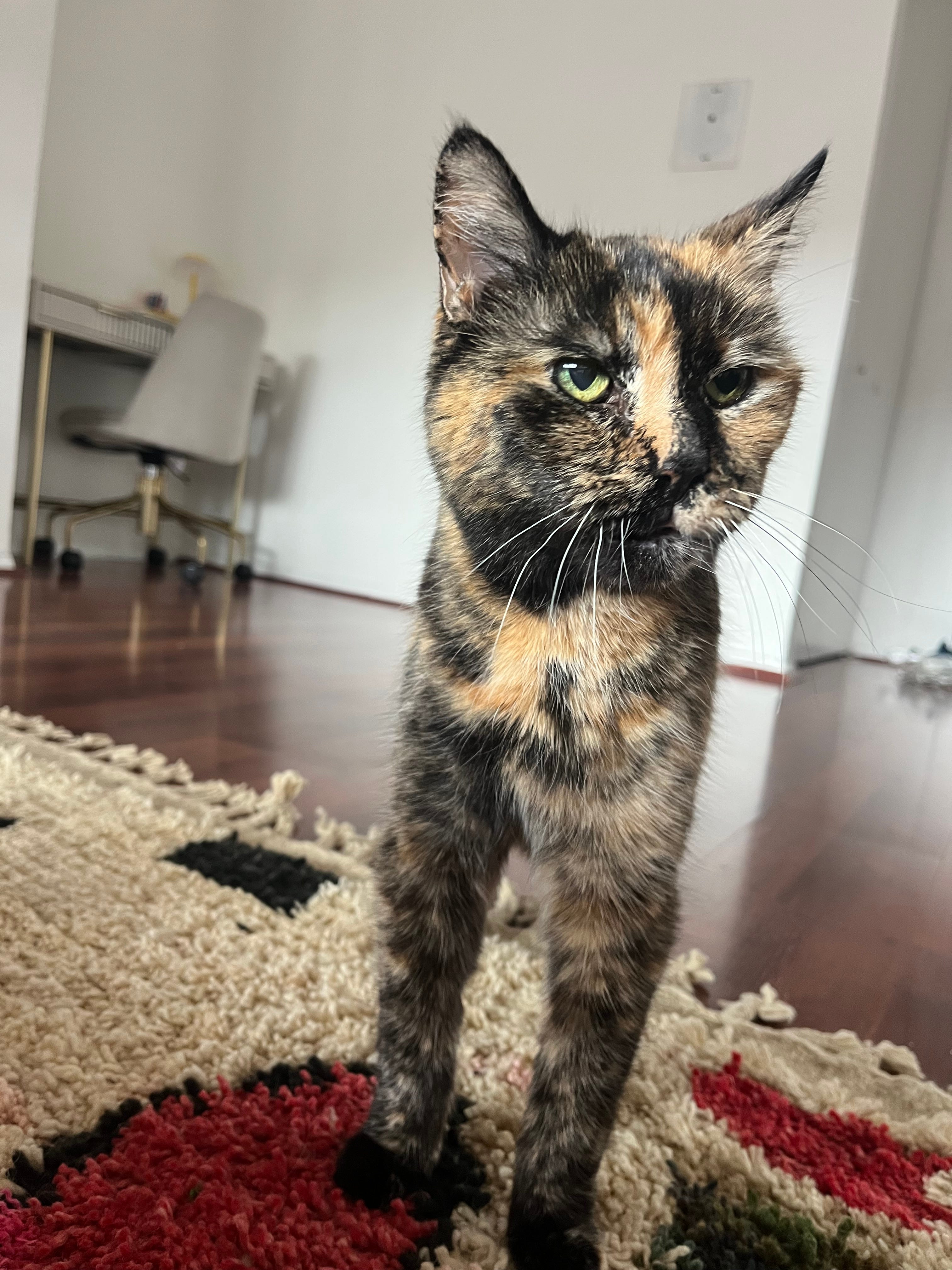
First thing’s first: I know this is a heated topic, and if you choose to read further, you have to solemnly swear to keep it together. If you have an indoor-only cat, please don’t start letting them outside because you read this newsletter. Don’t do it! If you find yourself getting heated while reading, just scroll back up and look at this picture of my friend-of-a-friend Cat.
If you live in an urban part of the United States, and you adopted a cat through a rescue, chances are you signed an adoption agreement in which you promised to keep your cat indoors only. This is now standard, at least in my experience - rescue practices vary dramatically throughout the country and I can’t claim to know what people are up to outside of the Northeast, but in New York, the expectation from private rescues is that rescued cats stay inside. There are many arguments for this - one of the most prevalent ones is that indoor-only is the most humane option, because it keeps cats safest. After all, you can’t get hit by a car or catch a parasite if you’re never outside.
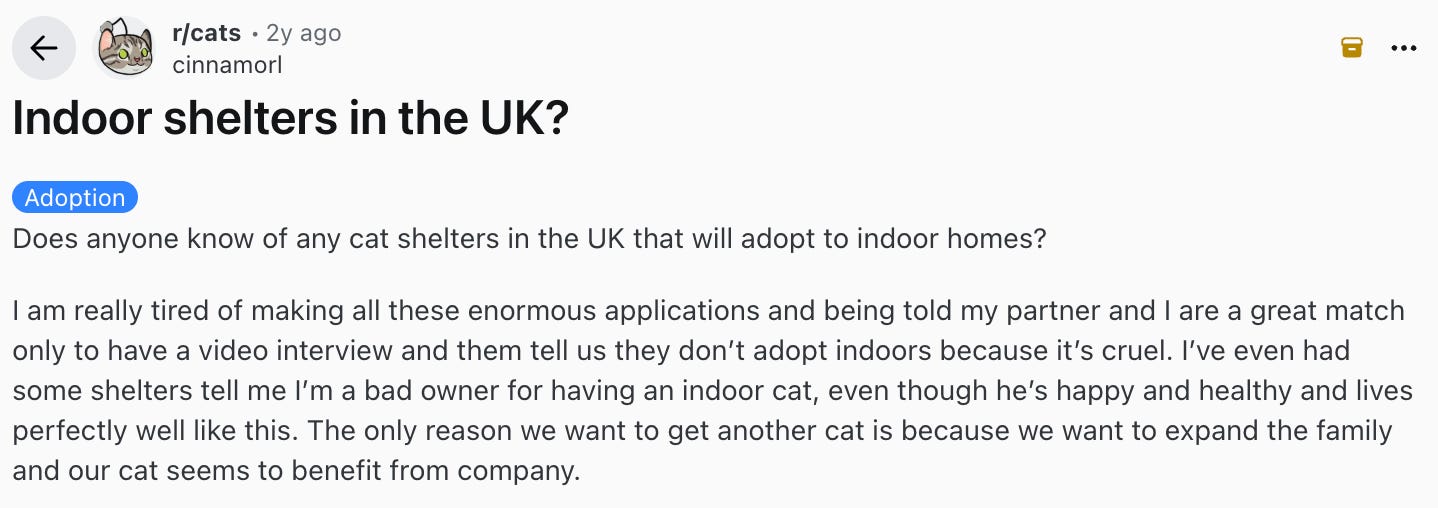
So I was surprised last year when I went to London, and learned that the opposite is true in the U.K. - most rescues require that the cats they adopt out will have outdoor access. While some smaller charities in cities focus on indoor-only placement, and some cats get indoor-only placement due to their age or health conditions, the ideal set-up for U.K. rescuers is an indoor-outdoor one. Per these rescuers, indoor-outdoor is the most humane option, because it’s best for the cat’s mental health. While the risk of injury is higher, indoor-outdoor cats are able to roam and hunt and adequately enrich their lives.
Perspectives on the indoor vs. indoor-outdoor question are highly regional. In this study from 2021, researchers surveyed cat owners internationally to see which lifestyle was more predominant across three regions (the U.S. & Canada, Europe, and Australia & New Zealand), and why owners chose the lifestyle they did. They found that 80.6% of respondents from the U.S. and Canada had indoor-only cats (higher than the usually reported statistic, which is 60%). On the other hand, only 30.2% of European respondents and 42.2% of AUS/NZ respondents kept their cats indoor-only. The most common reason given for providing cats with indoor-outdoor lifestyle was for the cat’s mental health, and because they believed indoor-only cats were prone to severe behavior issues.
Now: my cats are indoor-only. This is because I live in a city, and like many of those survey respondents, I worry about them being injured in an accident. I also worry about wildlife. Cats are opportunistic hunters, meaning they have evolved to hunt whenever they have the chance to, regardless of how much food is available to them. They can decimate wildlife populations. The impact is especially brutal in Australia, an indoor-outdoor culture where cats have contributed to the extinction of 20 mammalian species and kill an estimated 1.5 billion animals every year. There are lots of reasons to not allow cats to roam outdoors, and that’s where I personally fall in this conversation.
But also: the indoor-outdoor people aren’t wrong about cats’ mental health. Cats were allowed to roam freely until very recently, and most haven’t been selectively bred to live in confinement with humans. Feral cats hunt for 8 to 12 hours per day. Well-fed indoor cats hunt for about 3 hours per day, but most aren’t getting that much stimulation. Many behavior issues that owners report are a result of inadequate enrichment - these behaviors, like scratching or vocalizations, are normal behaviors that show up in undesirable ways because cats don’t have alternative ways to express them. In other words, these nuisance behaviors happen because cats are bored out of their little skulls.
Is it possible to acclimate indoor-outdoor cats to living indoors only? There’s a recent study that shows the cats adapt…but the people struggle. The human participants felt sad that their cats couldn’t go out and spend time with their friends, and their perception of what the cat was missing out on had a large impact on whether they kept their cat inside going forward. Research has also shown that indoor-outdoor cat owners are not good at estimating their pet’s level of predation, making them more resistant to understanding the impact that their cats may be having on the environment. Human perception is, as always, the biggest dictator of how cats are cared for.
Can you apply this to your own cats?
If indoor-only cats are bored out of their minds, is there anything you can do about it (short of letting them outside)? Enrichment, baby! This can look like interactive play, structuring their environment to give them more vertical spaces, food puzzles and other games, clicker training - all sorts of stuff to keep them engaged in species appropriate activities.
“But Julia,” you might be thinking, “That sounds really overwhelming.” That’s totally fine. You don’t have to adopt a ton of new habits immediately, and you don’t have to start playing with your cat for 3 hours per day. Even adding a few minutes here and there - a 3-minute clicker training session while you wait for your coffee to percolate, or 5 minutes with a wand toy between meetings - makes a huge difference. We owe our cats full lives, and the best way to provide that is to do so in a way that’s sustainable for us humans.
Cat fact:
Free-ranging cats are estimated to kill between 1.3 and 4.0 billion birds per year in the United States.
What I’m reading / watching:
The premiere book on interactive play for cats is Play With Your Cat! by Dr. Mikel Maria Delgado - for those looking to learn more about enrichment, I can’t recommend it enough.
I saw Nightmare on Elm Street 3: Dream Warriors for the first time recently (I know, massive blind spot). Wow, what a blast! If you enjoy practical effects and you also haven’t seen it, bump it to the top of your October spooky movie list. Hell, bump it up there even if you have seen it.
Currently reading When The Wolf Comes Home by friend-of-BHS Nat Cassidy. It’s a real party!
Non-cat related events
Wednesday, 10/29, 8:00PM: Horror trivia and pumpkin drop at Lucky 13 Saloon! What’s a pumpkin drop? It’s a cleansing ritual where all of your anxieties and pain are placed into a pumpkin and transformed into candy! Put it on your calendar!
Friday, 10/31, 9:00PM: I’m a special guest at Til Death Do Us Party - if you’re still looking for a Halloween party to attend, this one is available!
More promo stuff
Want to come up with ways to enrich your cat’s life? I’m a feline behavior consultant, and I’d love to help you out. You can learn more here: